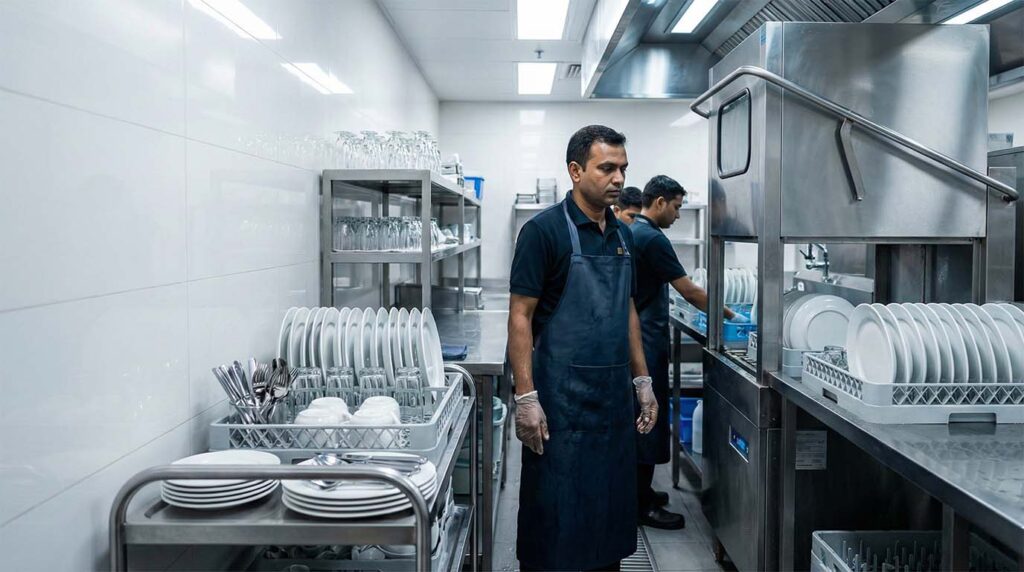
In my years of hospitality experience, especially working as a F&B professional, one consistent challenge I’ve seen is the lack of planning and space allocation for the dishwash area. Surprisingly, not much is spoken or written about it – yet it silently decides the efficiency of F & B operation.
Want to understand its importance? Just take a round of the dishwash area after:
-A busy breakfast service
-Heavy banquet clearance
-Peak dining hours
You’ll immediately see the critical role it plays in F&B operations.
Unfortunately, architects and owners often overlook this space, treating it as secondary. The reality is, a well-designed dishwash area ensures:
-Improved workflow – your team spends more time with guests instead of struggling with soiled crockery.
-Reduced breakages – especially when using premium, high-cost crockery.
-Better hygiene standards – a poorly designed area can quickly turn unhygienic.
-Higher staff morale – KST (Kitchen Stewarding) is already one of the toughest departments to staff; an ill-planned dishwash area only adds to their frustration.
-Operational savings – less wastage, lower replacement costs, and smoother turnaround time between covers.
In my view, the dishwash area is not just a back-end utility space; it’s the engine room that keeps F&B moving.
So, while planning a hotel, owners and architects must give it the importance it truly deserves.
After all, guest experience is built not just in the front-of-the-house, but also by the efficiency of the spaces no one sees.
Because sometimes, the smallest spaces make the biggest impact.
![The Hotel Adviser [Hospitality consulting Specialist]](https://www.thehoteladviser.com/wp-content/uploads/2026/02/Png-logo.png)